
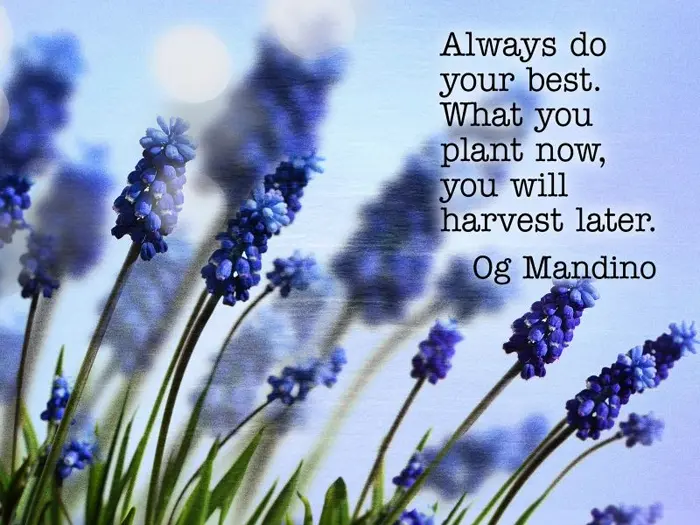
 That’s a beautiful quote from Og Mandino. “Always do your best. What you plant now you will harvest later.” It has that perfect blend of quiet, steady hope.
I was reading it this morning and it made me think. It sounds so simple on the surface, but it has real depth once you slow down and sit with it.
It’s easy to picture “our best” as some huge, heroic effort we have to make every single day. Running a marathon, finishing a whole book, closing a big deal in one sitting. When we can’t manage that, we beat ourselves up and call it failure.
But what if doing your best isn’t about being perfect, or being on form 100% of the time?
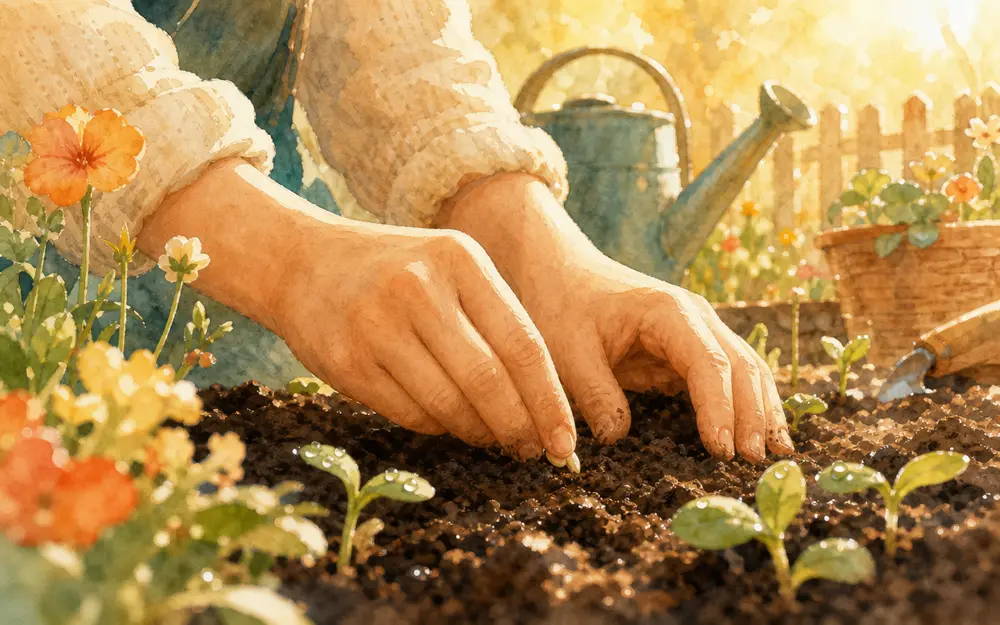
Think about that word, plant. Planting a seed is one of the most anticlimactic acts you can imagine. You dig a tiny hole, drop a little brown dot into it, and cover it back up. No applause. You can’t even see it working.
It’s the smallest, quietest act of faith. And that’s often exactly what doing your best looks like.
Your best can be small, and still count
The mistake we make is measuring our success by the harvest before we’ve even learned how to plant. Some days your absolute best is ten minutes looking at a course you want to take. Some days it’s getting one task done without scrolling. Some days, honestly, it’s just getting through without losing your temper.
The point isn’t how big the act is. The point is the quality of the seed. Was it your true best for that moment?
A gardener would never look at a tiny dry seed and call it worthless just because it isn’t green yet. They see the potential, not the present state. Same rule applies to your time and energy. If you can only give fifteen minutes to something you care about, make those the best fifteen minutes of focus you have. That’s a high-quality seed, and that’s what counts.
Why waiting for results before you start never works
We’ve all done it. We wait to act until we’re guaranteed a good harvest. We put off starting something new because we’re not sure it will succeed, and we don’t want to invest our time for nothing.
The catch is that a seed gives you nothing back for a while. No shoot, no colour, no sign you did anything at all. That silence is where most people quit, and it is the whole difficulty with planting rather than harvesting.
Og Mandino isn’t promising you’ll be a millionaire by next week. He’s promising that the type of seed you plant is the type of life you’ll get. Plant lazy seeds and you harvest a stagnant life. Plant consistent, focused effort, your actual best, and you will harvest something meaningful.
The progress you can’t see yet
So here is the question worth sitting with. What small, quiet, unglamorous thing could you do today that will show you absolutely nothing in return?
Not the thing that pays off this week. The thing that pays off in a year, if you keep at it, and gives you no encouragement at all in the meantime. That is the seed. Everything that looks impressive later is just one of those, planted often enough and long enough ago that people mistake it for talent.
The clarinet I bought three times
When I was eighteen I wanted to learn the clarinet, so I bought one. I didn’t practise regularly, and I stopped after a couple of months. In that time I had learned to read music, and picked up a lot of the basic notes and finger positions. I could play a passable tune. I was never going to be in an orchestra, but that wasn’t the intention anyway.
Years later I decided I would like to try again. I started from the beginning, because the intervening years meant I had forgotten almost everything. And yet again, after a few months of irregular practice, I stopped.
Fast forward to the age of fifty-two, and I bought another clarinet. This time I took lessons from a teacher, at least once a week for many months, and he gave me exercises to try at home. The tone I got after that much practice was significantly better, to the extent that I was invited to play to a crowd of local people. I was terrified, of course, in the way I have written about elsewhere. But afterwards a couple of them came up and gave me warm appreciation for what I’d played, because the tonality was much nicer than I had imagined it was.
That was simply the repetition of a physical skill. You could say I took something in the region of forty years to reach that level. But I didn’t give up, and I got there in the end, to a level I was happy with. Nothing professional, no qualifications. But I could knock out a tune that was pleasant to listen to.
Fast forward again. Now, at sixty-seven, I have taken up the saxophone. I don’t expect it to sound brilliant, and it doesn’t. But I will keep practising until I reach a standard I am happy with. The saxophone practice will enhance the clarinet practice, and then I will have two different instruments I can play whenever I want to.
I planted that first seed a long, long time ago. My harvest took a long time coming, but you know what, it came in the end. Some seeds grow fast, some grow slow. But they all grow at their own pace, and they all do better with regular care.
There’s a saying: it ain’t over till the fat lady sings. In my case it ain’t over until I can play a tune.
Start to finish? Fifty years.
Related: the companion to this one is why you never have enough time, which takes the same idea from the other end: not what you plant, but what it costs you to keep delaying. And if the hard part is getting yourself moving in the first place, here is how to motivate yourself when nobody else can.